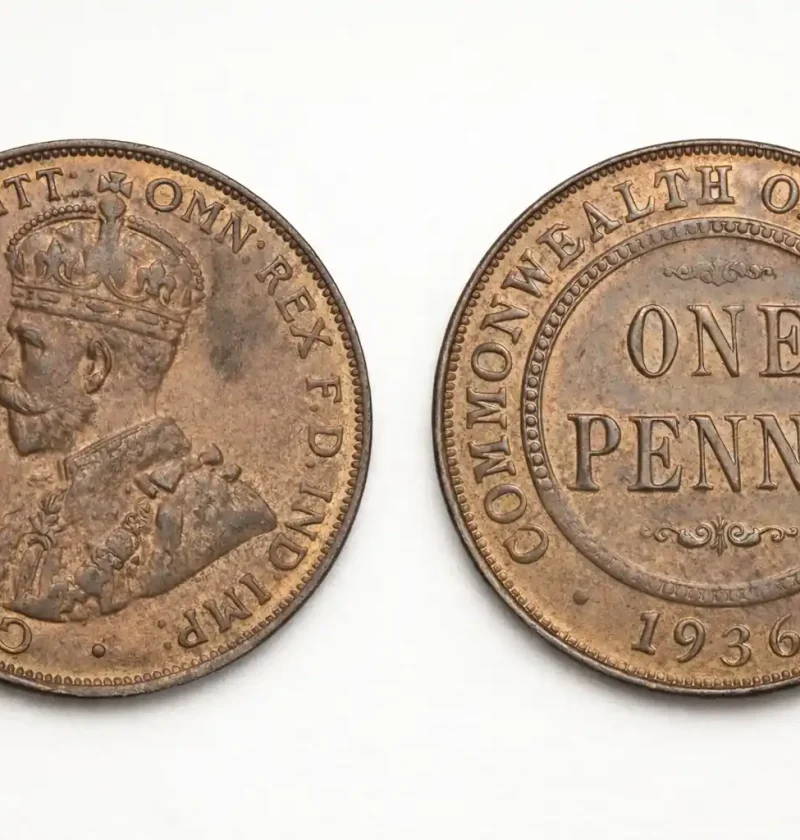
The 1936 Australian penny value depends on grade more than age. This coin is old, but it is not rare in worn condition. Most pieces stay modest in price. Strong detail, clean surfaces, and original color change the picture fast.
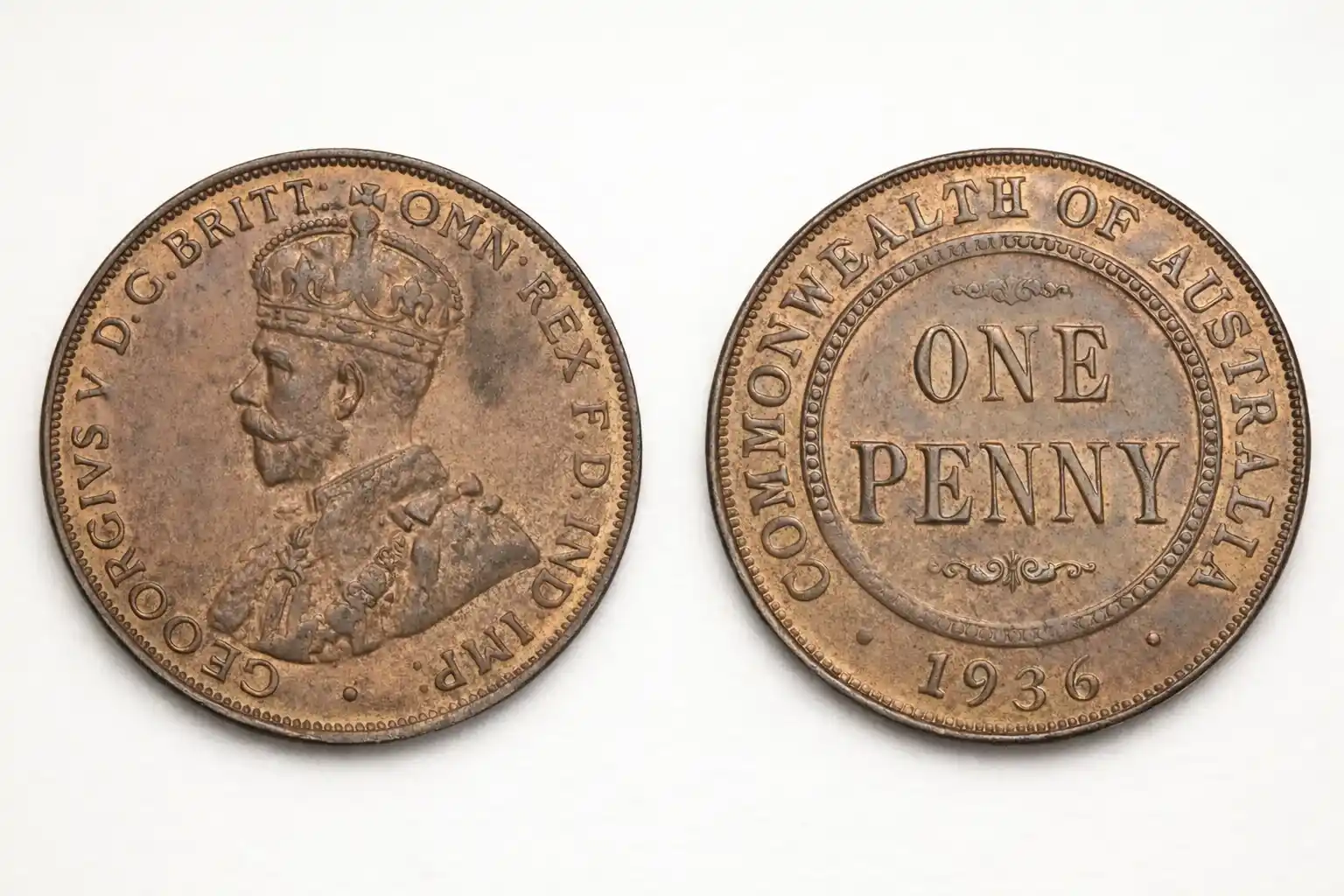
The 1936 penny is the last regular George V penny of the Australian pre-decimal series. It was struck in bronze, measures 30.8 mm, weighs about 9.4 to 9.45 grams, has a plain edge, and had a mintage of about 9.89 million. That makes it collectible, but not scarce in lower grades.
What Is the 1936 Australian Penny
This is a standard circulation coin of the old Australian pound system. The obverse shows George V. The reverse carries the classic Commonwealth design with ONE PENNY inside a beaded circle and decorative scrolls. It belongs to the long 1911–1936 George V penny run.
For collectors, the date matters for two reasons. First, it is the final year of the George V penny type. Second, it is common enough to be affordable in circulated grades, so buyers can focus on quality instead of chasing sheer rarity. That makes it a good teaching coin. It shows clearly how wear, color, and damage shape the value.
1936 Australian Penny Value at a Glance
The market range is wide because conditions change everything. A dark, worn piece and a clean, uncirculated coin do not belong in the same price bracket. Retail guides for this date show the spread clearly.
| Grade | Typical value range |
| VG | $1 |
| F | $2 |
| VF | $8 |
| EF | $35 |
| aUnc | $83 |
| Unc | $250+ |
These ranges are only a starting point. Better color, cleaner surfaces, or certified quality can push a coin higher. Damage, cleaning, or rough bronze can pull it down fast.https://apps.apple.com/us/app/coin-id-scanner-value-checker/id6523429889
At this stage, even the best coin identifier app only helps with the basics. It can confirm the type, date, and general specs. It cannot judge originality, surface texture, or market strength on its own. Those parts still need a collector’s eye.
What Drives the Value of a 1936 Australian Penny
Grade comes first. That is the main rule with this date. Most surviving pieces are worn. Once the coin keeps stronger detail and moves into EF, aUnc, or Unc territory, the price gap becomes much wider. A recent Stack’s Bowers auction result for a certified 1936 penny shows how even a better brown example can bring a real premium over common raw pieces.
Surface quality matters almost as much. Bronze is unforgiving. Hairlines, scratches, rim knocks, green spots, roughness, and old cleaning all cut into value. Two coins with the same basic wear can trade very differently if one looks honest and the other looks stripped or damaged.
Color also changes the market response. Many 1936 pennies are brown. That is normal. Red-brown pieces with more original life usually get more attention. Bright color is not always a positive sign, though. On old bronze, an unnatural flash can mean cleaning or recoloring. Collectors usually pay for originality, not shine.
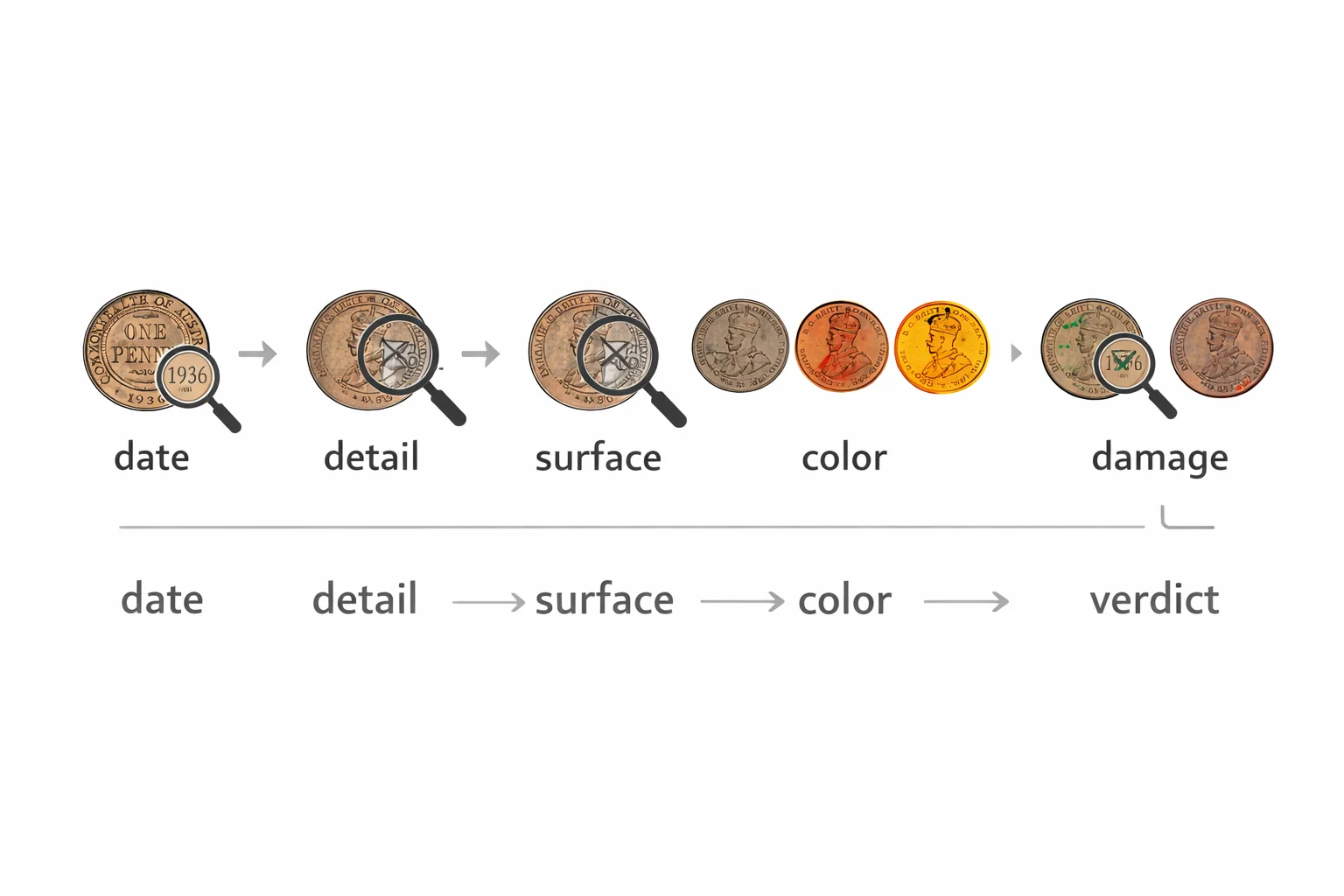
A quick checklist helps:
- Grade
- Surface quality
- Color
- Originality
- Damage
If one of these drops sharply, the price usually follows.
How to Grade a 1936 Australian Penny
Start with the big picture. Look at the main design first, not the date alone. In lower grades, the coin loses sharpness across the portrait and reverse details. In stronger grades, the design stays more defined, the fields look less tired, and the coin keeps a more even appearance.
Then check the surfaces. Many beginners confuse marks with wear. They are not the same. A coin can have full detail and still be unattractive because it was wiped, knocked, or stored badly. The reverse can stay bold while the fields turn dull. That is why a single number grade never tells the whole story on old bronze.
The easiest practical split is this:
- Low grade: Heavy wear, soft detail, dark or rough surfaces
- Mid-grade: Clear type, readable legends, moderate wear, average eye appeal
- Better grade: Strong detail, less flattening, cleaner fields, stronger collector appeal
- Uncirculated: No circulation wear, much sharper look, higher price sensitivity
That simple structure works better than overcomplicated grading language for most buyers.
Collector Red Flags
This date has several warning signs that matter more than many new collectors expect. A cheap problem coin often stays cheap. A better example stays liquid.
| Problem | Why it hurts | Market effect |
| Cleaning | Removes original surface | Lower demand |
| Corrosion | Damages the bronze texture | Sharp discount |
| Porosity | Leaves rough fields | Weak eye appeal |
| Rim damage | Reduces integrity | Harder resale |
| Artificial color | Raises doubts | Buyer caution |
Cleaning is the biggest trap. A cleaned 1936 penny may look brighter in a photo, but under light, it often shows hairlines, dead fields, or an unnatural tone. Many collectors would rather buy a darker, honest coin than a bright one with disturbed surfaces.
Corrosion and porosity are also serious. Bronze reacts badly to poor storage. Green spots, pitting, and uneven roughness can turn a decent date into a filler coin. This matters because the 1936 penny is not rare enough to excuse major problems in most grades.
Rim knocks and bends matter too. They may look small, but they hurt the coin’s profile and resale appeal. On a date that collectors can usually replace, buyers become selective. They do not need to settle for damaged metal unless the price is very low.
How to Tell If a 1936 Penny Is a Solid Collector Piece
A strong collector coin does not need to be mint state. It needs to be honest. Clear detail, stable color, decent surfaces, and no major damage already place a coin above the ordinary group. That is the level where this date becomes enjoyable to own.
A filler example is different. It has the date. It fills the hole. But it may be too worn, too rough, too cleaned, or too flat to hold much premium. There is nothing wrong with a filler coin if the price matches the coin. The mistake comes when buyers pay a high price for weak quality.
A simple buying split helps:
- Budget coin: Worn but problem-free, low cost, good for a basic set
- Better coin: Stronger detail, more original look, more room for long-term appeal
That is a more useful way to think than asking if the coin is “rare.”
Coin ID Scanner can be useful here for the sorting stage, not the final judgment stage. It can help confirm the type, pull up a coin card with baseline specs, and keep scans organized inside a collection. Its database covers more than 187,000 coins, and the app can show details like country, years, composition, weight, diameter, and edge. That makes it practical when a collector is working through mixed world material or family holdings.
It also helps with routine workflow. A collector can scan the coin, confirm that it is the standard George V Australian penny type, save it, and move on to manual grading. That last part still matters most. No app can fully read cleaned bronze, weak surfaces, or true market eye appeal from one photo.
Buying and Selling Advice
If you are buying, pay for quality, not for the date alone. A modest VF or EF coin with stable surfaces is usually a better purchase than a so-called uncirculated piece with cleaning, spots, or color problems. The 1936 penny is available enough that patience pays off.
If you are selling, keep the description plain and honest. Mention wear. Mention spots. Mention cleaning if it is obvious. Clear photos do more than inflated language. Buyers of Australian pre-decimal bronze want to see the real coin, not a sales pitch.
FAQs
Is the 1936 Australian penny rare?
Not in lower grades. It had a mintage of about 9.89 million and is generally available in worn to mid-grade condition. Better uncirculated pieces are much harder to find and much more expensive.
What is a circulated 1936 penny worth?
Typical circulated guide levels run from about $1 in VG to around $35 in EF. The exact price still depends on color, damage, and overall look.
What makes one coin worth more than another?
Grade is the first factor. After that come surface quality, originality, color, and the absence of cleaning or corrosion. On this date, those points matter more than beginners often expect.
Does cleaning reduce value?
Yes. Old bronze coins usually lose collector appeal after cleaning because the surface changes. Hairlines, odd brightness, and artificial color often follow.
Is an uncirculated 1936 penny expensive?
It can be. Published retail guides place uncirculated examples at $250 and up, and stronger certified coins can move higher depending on color and grade level.
Final Verdict
The 1936 Australian penny is a practical collector coin. It is not a great rarity in worn grades. It becomes interesting when quality improves. Grade, surfaces, color, and originality decide the value. Cleaning, corrosion, and rough bronze are the main red flags. Buy the best honest coin you can afford, and this date makes much more sense.